
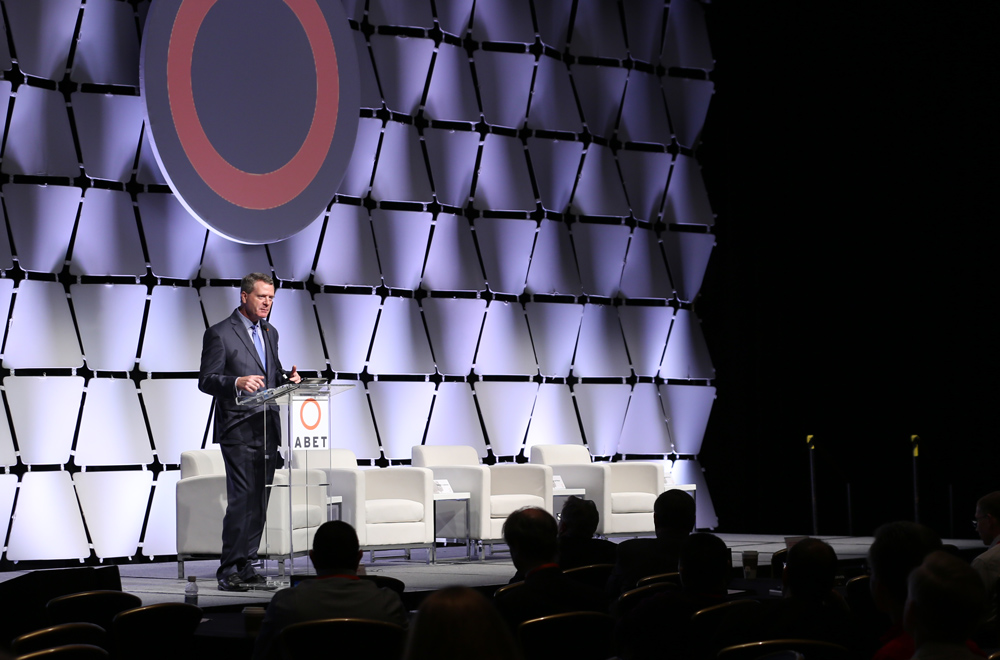
When it comes to helping shape the quality of higher education programs around the globe, the quality assurance organization ABET provides the gold standard. ABET’s programmatic accreditation criteria have also been at the forefront of promoting sustainability and environmental and social responsibility for fields such as engineering education.
There have been few greater champions for sustainability than ABET’s CEO Dr. Michael K. J. Milligan. From his education as an electrical engineer to a career in the Air Force and NASA, he brings a broad perspective of the different needs of students, educators, and industry. And perhaps it’s his work for NASA that helped him develop a keen appreciation for the wonder and fragility of our planet.
Milligan has been a key collaborator with Engineering for One Planet (EOP) since its creation, and ABET provides the roadmap for key student outcomes that the EOP Framework is aligned with.
We recently spoke with him about why the call for sustainability in engineering is greater now than ever — and how EOP is acting as a bridge for programs to incorporate the sustainability and leadership skills, experiences, and behaviors our students need to build a better future.
This interview has been edited for length and clarity.

Integrating Sustainability
Can you describe the purpose of ABET and how it helps shape the next generation of engineers?
The role of the engineer has always been to advance technologies for the benefit of society, people, and our planet. Our core purpose at ABET is also simply to make the world a better place. We do that by working together with our partners across higher education and industry to prepare students to have an impact as they transition into the workforce, and setting them up to have the best success possible.
Students nowadays are very socially aware. They’re very conscious of the challenges that we face, which are very large, complex, and difficult. And fundamentally, it’s about their own future.
They really want to know: What difference will my work make? What can I do to improve the planet and to help society in general?
How has ABET helped promote a focus on sustainability in the programs that it accredits?
We first introduced sustainability topics into our criteria in 2009 for programs to show that students have had some exposure to it and can design solutions with a sustainability mindset. This has only grown in importance because of what we’re seeing around the world today with the climate crisis and Earth’s limited natural resources.
We want sustainability to be part of students’ experiences throughout their entire undergraduate or graduate career — so that it just becomes part of how they think, and not a separate thing or add-on that they consider at the very end.
Overcoming Road Blocks
What are some of the roadblocks that educators and programs face in preparing their students for sustainability?
Faculty and administrators are always challenged with pressure to get students to graduate on time. In this current environment, there’s so much more that the students need to know. And the technology has advanced in basically every area, so that you’re constantly trying to get students exposed to new topics and look at the trade-offs.
The question is how do you get sustainability in there without having to pull other things out. The key is to integrate it into existing curricula — and the answer to that is the EOP Framework.
How have you seen the EOP Framework and teaching guides help institutions embrace sustainability, instead of just seeing accreditation as another compliance hurdle?
The EOP Framework is a perfect way to integrate the sustainability topics that we think are so important into students’ education. When I was first introduced to EOP, I was blown away because it exactly hit on what we at ABET were thinking in terms of what students need to know — and how to make it as easy as possible to get that into lectures or a design experience so it doesn’t overburden professors and departments with trying to put more into an undergraduate program.
The EOP Framework and companion teaching guides are great because they have many exercises and activities that educators can pull directly into their courses. They will guide them step-by-step on how to integrate sustainability activities into their classes — from exactly how much time to allow for the activities to what kind of outcomes to expect. I almost say it’s magical because the solutions are just there for the taking, and they’ve been vetted and they’ve been used by diverse institutions and programs.

Mapping to ABET Criteria
How does EOP ensure that it aligns with the most important concepts that students need to know, and that it supports the technical rigor that ABET looks for?
One of the real benefits that the EOP Framework accomplished was mapping back to ABET criteria. ABET is very cognizant of being non-prescriptive and allowing institutions to do things innovatively. We have almost 5,000 programs accredited in 42 countries — all of those are very diverse, and they’re all going to introduce these topics in their own way at the right time. We want to give them the freedom to do that.
Can you give us a specific example of how one of EOP’s learning outcomes maps back to ABET’s student outcome criteria?
One of the learning outcomes — ABET’s Criterion 3, Student Outcome 2 in the Engineering Accreditation Commission (EAC) Criteria — focuses on getting students to understand how to make good design choices, with a heavy emphasis on sustainable design, techniques, and practices. The best way to do that is through integrating as much good design experience into the curriculum as possible, and that’s where the EOP Framework comes in.
The Framework allows us to look at questions like: How do we make sure the solution works with and for the people who are going to be using it? What’s the impact going to be on the environment? What are the ethical challenges we might face along the way in developing a solution?
Another thing that the EOP Framework allows us to do is to look at design problems from the perspective of circularity. It helps us consider a product’s lifecycle from beginning to end, which is so critical. Interestingly, that cycle is becoming shorter and shorter as technology advances. It’s a big challenge, but one that we want to prepare students to address.

Building a Community of Practice
The ABET Symposium this year was focused on the theme “Partnership with Purpose.” How have the EOP Network and community been important partners in ABET’s work to bring sustainability to engineering education?
One of the most valuable ways to help create this change — something that’s been proven over many years — is the peer-to-peer approach. You have faculty from a particular program and institution talking with faculty at another institution saying we’ve accomplished this, we’ve introduced these topics into our curriculum, and this is the way we do it and the kind of tools that we’re using.
Members of the EOP Network were able to say, “Look, the EOP Framework and these activities exist and directly support the achievement of some of the things that are in ABET’s criteria,” and only help you strengthen their adoption.
Equally important are peer-to-peer conversations between academia and industry, where practitioners can share examples from engineering practice, emerging expectations of employers, and the sustainability considerations engineers are increasingly asked to address throughout their careers.

You also collaborated with The Lemelson Foundation to create the EOP Innovation in Sustainability Award. What was the purpose behind that recognition?
It’s our way of highlighting real success that we’ve seen — either at the program level with individual faculty or at the institutional level — where the focus has been on doing something new and different in sustainability education.
We want to demonstrate the brightest and the best examples of introducing sustainability into curricula and into the students’ experience, and encourage more programs and institutions to move forward in that area.
ABET recently launched its Sustainability Microcredential in the form of a 25-hour, self-paced training. Why was it important to launch this right now for students and professionals?
There’s still a gap of people that need education in the area of sustainability, from current and former students to people that have been out working for a long time. We introduced our microcredential in sustainable design to provide them with some formal education in that area.
Credentials are now an important way to effectively demonstrate experience and expertise, and you see that through mediums like LinkedIn. If you look at someone’s professional profile, there’s a very large section for unique skills and abilities. We felt very strongly that by offering people the actual credential to go along with the experience of going through the coursework, that would be a good way to validate their working knowledge of sustainable design.
And it’s a big differentiator for employers. If I’m looking at a couple candidates for a particular job and one demonstrates not just an interest but a commitment to gaining expertise in sustainability, then automatically that person is going to be at the top of my list.
Looking Toward Sustainable Impact
How do you see the future trends toward sustainability in the engineering profession and in engineering education?
Sustainability is now in high demand. Students want to know about it, and schools understand that. Employers understand that too, and it’s what they want to see when they hire students. It’s becoming more and more embedded in the corporate value structure.
From my experience over these past several years of working with The Lemelson Foundation and EOP, I see this movement expanding. It was originally developed here in the U.S., but EOP is now global too. People are becoming aware of it as the go-to place to get resources to implement sustainability.
What keeps you motivated personally?
I’ve seen a huge amount of impact to our climate over the past 10 or 15 years. For the most part, we’re not headed in a good direction in terms of the health of our planet and species extinction. I have two grandchildren now, and I think about what their future will look like and what their experiences are going to be.
The students today are going to be the big problem solvers of tomorrow. They’re going to be the ones that are the game changers. And having them not just aware of what the challenges are, but making sure they have the knowledge, skills, experiences, and abilities to be successful in making a positive impact on our planet — that gives me hope.
